SAINA INTERNATIONAL / SOURCING
Private Label Sourcing
Private label sourcing starts with the product, the pack and the market. Saina International coordinates manufacturer and supplier discussions across dairy, agriculture, food and beverages, and industrial goods. Own-brand or OEM feasibility is assessed for the specific product and source.
INDIA ROOTED. GLOBALLY CONNECTED.
EXPLORE YOUR OPTIONS
From brief to possibility.
01
Product brief
Describe the product, intended customer, composition or performance requirements, and any reference specification. Clarify whether you need an existing product or a custom requirement.
02
Packaging brief
Identify the pack format, size, branding and artwork status. Packaging options, minimum quantities and market requirements must be discussed with the proposed source.
03
Supply brief
Share launch quantity, expected repeat demand, destination and desired timing. Treat feasibility, documentation and order terms as decisions to confirm.
BUILD A BETTER BRIEF
Good decisions start with the right details.
Explore the points below to shape your enquiry. Start with what you know; we can discuss the details that need clarification.
Keep product development and sourcing aligned
An attractive pack is only one part of an own-brand requirement. The product specification, suitable manufacturer, quantity and supporting information all need to fit the buying plan. Saina helps coordinate those discussions so the brief is useful for both buyer and source.
Ask the important questions before committing
Confirm which details the offer covers: product composition, packaging, artwork responsibilities, samples if available, documentation and expected supply terms. Do not assume that a general catalogue item is automatically available in your preferred branded format.
For private label sourcing, separate the cost of the product from the cost of the branded pack. Ask whether the quotation includes printing, labels, cartons, tooling or setup, and whether unused packaging becomes your responsibility. A lower unit price can be less useful if the minimum printed-pack quantity is much larger than your first order.
Agree how a proposed sample relates to the final order. A catalogue sample may demonstrate the base product without representing your artwork, pack material or finished specification. If sampling is available, record the version reviewed, the changes requested and the person responsible for approval. Keep a written reference that both parties can use when discussing production.
Compare timelines as separate steps: specification review, sourcing confirmation, artwork approval, packaging availability, production and dispatch. Ask which dates are estimates and which can be confirmed after the order details are agreed. This makes private label sourcing discussions more practical when a launch depends on several suppliers or approvals.
Think about the repeat order as well as the first shipment. Clarify how changes in ingredients, materials, packaging or manufacturing source would be communicated. Record the intended reorder quantity and any storage constraints so the proposed format can be assessed against your business needs.
Finally, make ownership and communication clear. Identify who supplies the brand assets, who checks artwork, who approves the specification and who coordinates destination requirements. Saina can discuss the sourcing scope with you; product-specific feasibility and responsibilities should be confirmed with the proposed source before a commitment is made.
Prepare private label sourcing for your market
Tell us where the finished product will be sold and what your business requires for review. Destination-specific packaging and labelling expectations should be identified early and checked for the actual product. Facility credentials and certifications need source-specific evidence rather than a blanket claim.
A useful private label sourcing brief explains the customer you intend to serve, the product format and the proposed sales channel. Distinguish the features that define your own-brand proposition from packaging preferences that can still change. An existing sample or reference specification can help explain the concept, but the final product requirements need to be agreed for the chosen manufacturer.
Plan how your team will approve samples, artwork and supporting information. Identify who checks technical suitability and who approves the brand presentation. If an initial launch quantity differs from expected repeat demand, provide both figures as planning context. Minimum quantities, production feasibility and the supply schedule depend on the specific product and source.
Private label sourcing also needs a clear record of responsibilities. Ask what the proposed offer includes and what your business must provide, such as artwork or buyer-defined packaging requirements. Confirm unresolved points before comparing prices. This approach applies across dairy, agriculture, food and beverages, and industrial products, although the technical details differ by category.
For general background on Indian export processes, consult the DGFT portal. Product and destination requirements should be checked for the actual transaction. General guidance does not establish that a proposed private label product has a particular approval or certification.
THE SAINA PORTFOLIO
Four categories. One connected approach.
Dairy, agriculture, food and beverages, and industrial goods—explore the category that fits your next requirement.

EXPLORE THE CATEGORY
Dairy
Skimmed Milk Powder, Full Cream Milk Powders, Unsalted Butter, Unsalted Lactic Butter, Frozen Cream, Anhydrous Milk Fat (AMF), Milk Protein Concentrate etc.
EXPLORE THE CATEGORY
Agriculture
Dry Red Chilli, Fresh Fruits & Pulp, A++ Grade/Super Negin quality Saffron.
EXPLORE THE CATEGORY
Food & beverages
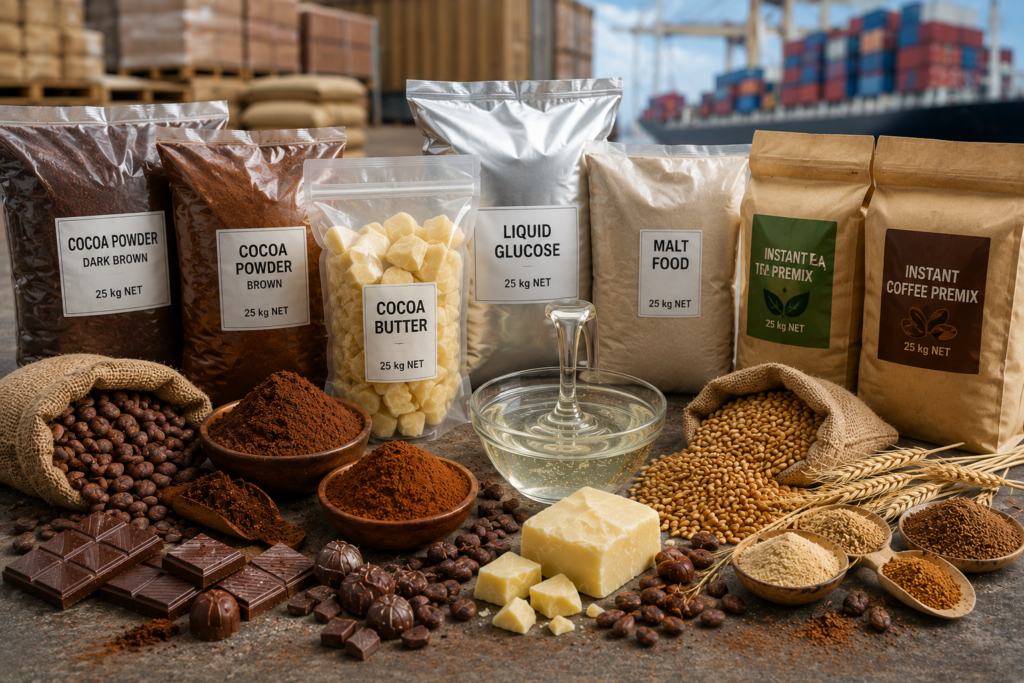
Malted Food, Chocolates & confectionery, Beverages & Instant Tea/Coffee Premixes.

EXPLORE THE CATEGORY
Industrial goods
100% Cotton Duck Canvas (Dyed & Greige) as per ASTM standard, Foundry Grade Metal Scrap HMS-I & HMS-II.
BEFORE YOU ENQUIRE
A little clarity goes a long way.
Can own-brand enquiries cover all four categories?
Yes. Enquiries can cover dairy, agricultural products, food and beverages, and industrial goods. Branding, packaging or OEM options depend on the product and manufacturer; feasibility is confirmed before an offer is agreed.
Can I start with a product idea?
Yes. Share the concept, intended use, target market and approximate quantity. Feasibility can then be discussed against potential sourcing options.
Are minimum quantities the same for every project?
No. Product type, manufacturer, packaging and customization affect the proposed quantities and commercial terms.
Does Saina manufacture private-label products itself?
Saina coordinates sourcing through manufacturer relationships. The manufacturing source and its capabilities are confirmed for the specific project.
KEEP EXPLORING
LET’S TALK TRADE
Your next requirement. Our next conversation.
Dairy, agriculture, food and beverages, or industrial goods—share the product, quantity, packaging and destination. Let’s discuss a practical way forward.